Materials guide · Bathroom
Bathroom Tile Guide: Porcelain vs. Ceramic vs. Natural Stone
Porcelain, ceramic, natural stone and glass compared for bathroom floors, shower walls and shower floors, plus the wear, water and slip ratings worth checking.
By the KitchenBathEstimates editorial team Published 7 min read
Porcelain is the best all-around bathroom tile for most homes. It absorbs almost no water, works on floors, walls and shower floors, and comes in convincing stone, concrete and wood looks. Glazed ceramic is a lower-cost choice that's excellent on walls and fine on many floors, natural stone suits people willing to seal it and treat it gently, and glass shines on walls and accents. For any floor tile, check two numbers on the spec sheet: the PEI wear rating and the DCOF slip rating.
Porcelain, Ceramic, Stone and Glass: The Differences
Porcelain
Porcelain is a type of ceramic tile defined by how little water it absorbs. Under the ANSI A137.1 standard, porcelain must absorb 0.5% or less of its weight in water. That dense body is why it handles showers, steam and mopping without fuss. The Tile Council of North America (TCNA) points out that porcelain is difficult, if not impossible, to identify by sight, which is why it and a distributors' group set up the Porcelain Tile Certification Agency. Ask whether a tile is PTCA-certified, or check the absorption figure on its spec sheet.
Ceramic
Ordinary (non-porcelain) ceramic tile has a more porous body; one major tile supplier puts typical absorption at 3% to 7% by weight. A glaze protects the surface, so glazed ceramic is a great wall tile and a reasonable floor tile when it carries the right ratings. It's generally the budget choice.
Natural stone
Marble, travertine and limestone are calcareous stones, made mainly of calcium carbonate. The Natural Stone Institute warns that products containing lemon, vinegar or other acids may dull or etch them, so they need neutral, non-acidic cleaners. Stone is porous and usually sealed, but sealing makes it more stain-resistant, not stain-proof. Granite and slate are siliceous stones, made mostly of silicate minerals, which the institute says generally resist most kitchen acids, though acidic cleaners still aren't recommended.
Glass and mosaics
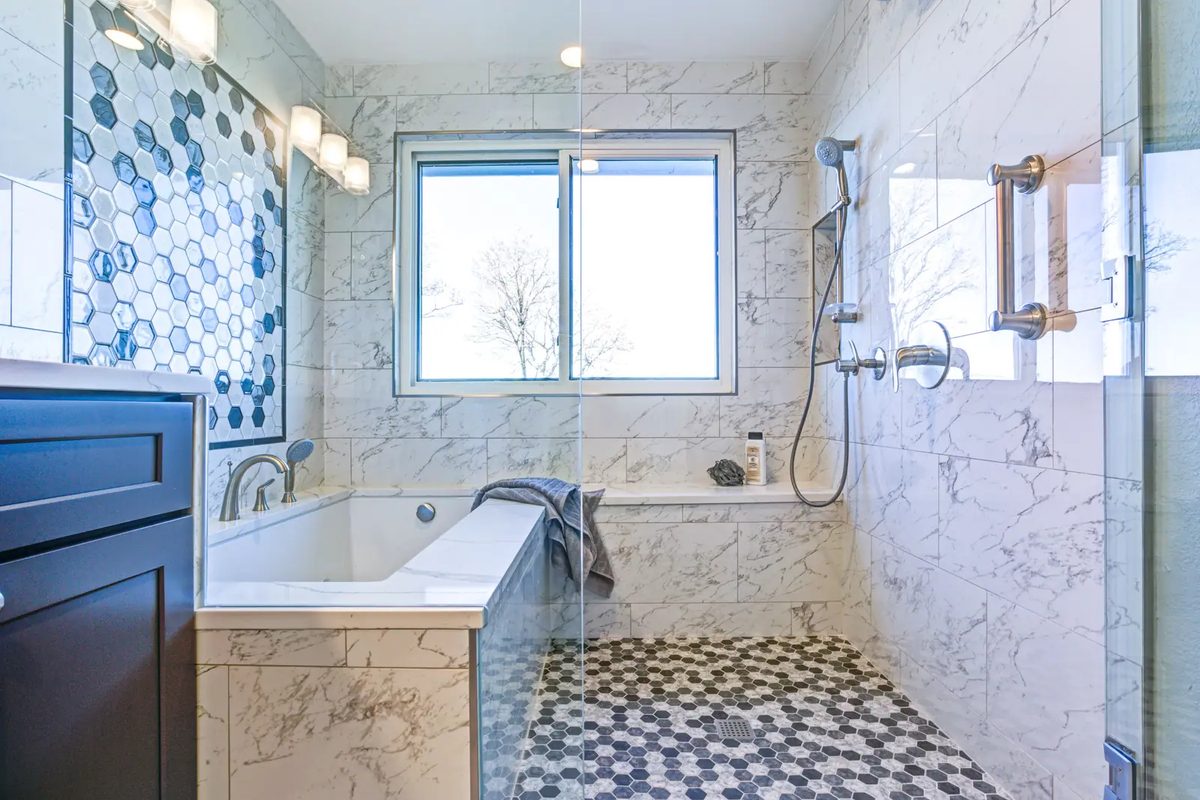
Glass tile has its own American National Standard, ANSI A137.2. It's nonporous and reflects light beautifully, which makes it a favorite for shower walls, niches and accent bands. Mosaics, small tiles mounted on mesh sheets, come in porcelain, ceramic, stone and glass, and they're the go-to for shower floors.
The Ratings That Matter
| Rating | What it measures | What to look for in a bathroom |
|---|---|---|
| Water absorption (ANSI A137.1) | How much water the tile body soaks up | 0.5% or less for porcelain |
| PEI class (ASTM C1027) | How well a glazed surface resists visible wear | Grade 3 or higher for floors; 1 or 2 is fine for walls |
| DCOF (ANSI A326.3) | Slip resistance on a wet floor | Interior Wet (0.42 or higher) for floors; Interior Wet Plus for shower floors |
PEI ratings come from a test of glazed tile; unglazed tile is tested a different way, so don't be surprised if an unglazed porcelain has no PEI number. One major supplier describes grade 3 as the standard for routine home flooring, including bathrooms, and grades 1 and 2 as suited to walls and areas with little foot traffic.
DCOF is the number that keeps people upright. The ANSI A326.3 standard sorts flooring into use classes. Its Interior Wet class, which covers home kitchens and bathrooms, calls for a wet DCOF of 0.42 or higher, or a manufacturer's declaration. Interior Wet Plus is declared by manufacturers for surfaces frequently under standing water, and shower floors are a listed example. Matte and textured finishes generally score higher than high-gloss ones, so save polished stone and shiny tile for walls.
Where Each Tile Works Best
| Tile | Bathroom floor | Shower walls | Shower floor | Upkeep |
|---|---|---|---|---|
| Porcelain | Excellent; check PEI and DCOF | Excellent | Good as mosaics or textured tile rated Interior Wet Plus | Low |
| Glazed ceramic | Good if rated for floors | Excellent | Only if rated for wet floors | Low |
| Marble, travertine, limestone | Possible in a honed finish; must be sealed | Good if sealed | Possible as mosaics; sealing and acid-free cleaners required | High |
| Slate, granite | Good; seal as directed | Good if sealed | Possible; check the finish for slip resistance | Moderate |
| Glass | Only if the maker rates it for floors | Excellent, often as an accent | Only if rated for it | Low; the grout needs the care |
Costs vary more with tile choice and labor than people expect. Fixr puts installed tile flooring at about $8 to $14 per square foot, with glass and mosaic labor alone running $12 to $14. For showers, its national average is about $2,700 for a 3-by-4-foot ceramic shower with a mosaic floor (typically $1,800 to $5,000), and its installed ranges run $17 to $46 per square foot for porcelain, $13 to $65 for marble and $19 to $65 for glass. For whole-room budgets, see our bathroom remodel cost guide.
Getting the Shower Floor Right
The shower floor is the toughest spot in the bathroom: wet, soapy and sloped. With a standard center drain, the floor must slope toward the drain from every direction, which limits you to mosaics or other small tiles. A linear drain lets the floor slope in a single plane, which opens the door to large-format tile; our walk-in shower ideas show how it pairs with a curbless entry.
Small tiles have a bonus. One major supplier recommends 2-by-2 to 4-by-4-inch mosaics because the extra grout lines add grip on a sloped surface, and mesh-backed sheets follow the slope naturally.
Our guide to shower wall options compares tile with panels and slabs if you're still deciding on the walls.
Choosing Grout
Grout gets more attention after installation than the tile does, so it's worth choosing deliberately. The four main types each have their own ANSI standard:
- Standard cement grout (ANSI A118.6). The most economical. Sanded grout is for joints from 1/8 to 1/2 inch; non-sanded is for joints 1/8 inch or smaller and for polished or soft tiles such as glass and stone. It's the most porous type and should be sealed, with the sealer reapplied every two to three years depending on cleaning habits.
- High-performance cement grout (ANSI A118.7). Denser and more stain-resistant than standard grout, and it doesn't require sealing.
- Single-component grout (ANSI A118.19). Sold premixed in a bucket, stain-resistant, and no sealing needed.
- Epoxy grout (ANSI A118.3). The most stain- and chemical-resistant option, and more resistant to mold and discoloration than ordinary cement grout. It's also the most expensive of the four.
For a shower, the upgrade from standard grout to a high-performance, single-component or epoxy grout is usually money well spent, because it takes resealing off your to-do list.
Installer skill matters as much as material. TCNA's ACT program (Advanced Certifications for Tile Installers) includes hands-on certifications for showers, membranes, grout and large-format tile, so it's a fair question to ask. Check each contractor's license and insurance yourself through your state licensing board and a certificate of insurance; our guide to choosing a remodeling contractor explains how.
Find a Local Bathroom Remodeler
Tell us about your bathroom and we'll introduce a remodeling contractor who serves your area; it's free, there's no obligation, and your details go only to a contractor you approve.
Get Free EstimatesFrequently Asked Questions
Is porcelain or ceramic tile better for a bathroom floor?
Porcelain, for most people. It absorbs 0.5% or less of its weight in water, which makes it the safer choice for floors that get wet. Glazed ceramic can work well too if it's rated for floors (PEI grade 3 or higher) and for wet areas (DCOF of 0.42 or higher), and it usually costs less.
What PEI rating do I need for a bathroom floor?
Look for grade 3 or higher. One major supplier calls grade 3 the standard for routine home flooring, including kitchens and bathrooms; grades 1 and 2 are meant for walls and low-traffic areas. Unglazed porcelain may not carry a PEI number because it's tested differently.
What DCOF rating is safe for a bathroom floor?
Under ANSI A326.3, tile in the Interior Wet class, which covers home bathrooms, should have a wet DCOF of 0.42 or higher or carry the manufacturer's declaration for that use. For shower floors, look for tile the manufacturer declares as Interior Wet Plus. Matte and textured finishes usually grip better than glossy ones.
Can you use marble tile in a shower?
Yes, with commitment. Marble needs sealing and neutral, acid-free cleaners, because acids can dull or etch it, and sealing reduces staining without preventing it. Expect more upkeep than porcelain, which can mimic marble's look with almost no maintenance.
Does porcelain tile need to be sealed?
The tile itself generally doesn't, since it absorbs so little water. Standard cement grout should be sealed, though, and resealed every two to three years. High-performance cement, single-component and epoxy grouts don't require sealing.
What size tile is best for a shower floor?
With a center drain, small mosaics in the 2-by-2 to 4-by-4-inch range are the usual choice because they follow the four-way slope and the extra grout lines add grip. If you want large tiles underfoot, plan for a linear drain, which lets the floor slope in one direction.
Sources
- Tile Council of North America – 2026 TCNA Tile Initiative
- Crossville – Porcelain Tile DCOF Ratings and Applications
- MSI – Best Porcelain Tile for Bathroom Floors: Slip and Moisture Guide (2026)
- MSI – Porcelain Tile Grades Explained
- ASTM International – C1027 Standard Test Method for Determining Visible Abrasion Resistance of Glazed Ceramic Tile
- Natural Stone Institute – Cleaning Products for Natural Stone
- Custom Building Products – Grout Choices for Designers (2024)
- Schluter Systems – Waterproofing Membrane for a Shower
- Schluter Systems – Shower with Linear Drain
- Fixr – Tile Flooring Installation Cost
- Fixr – Shower Tiling Cost